Edition No. 14 · By the DupeHaven editors
A Cutting Board That Lasts, and the Knife to Go With It
A good board and a sharp knife make cooking faster, safer and more fun. A beautiful board can also stay out on the counter and warm up the whole kitchen. Here is how to choose both, at three prices.
Some links on this page may earn us a commission at no extra cost to you. How this works. As an Amazon Associate I earn from qualifying purchases.
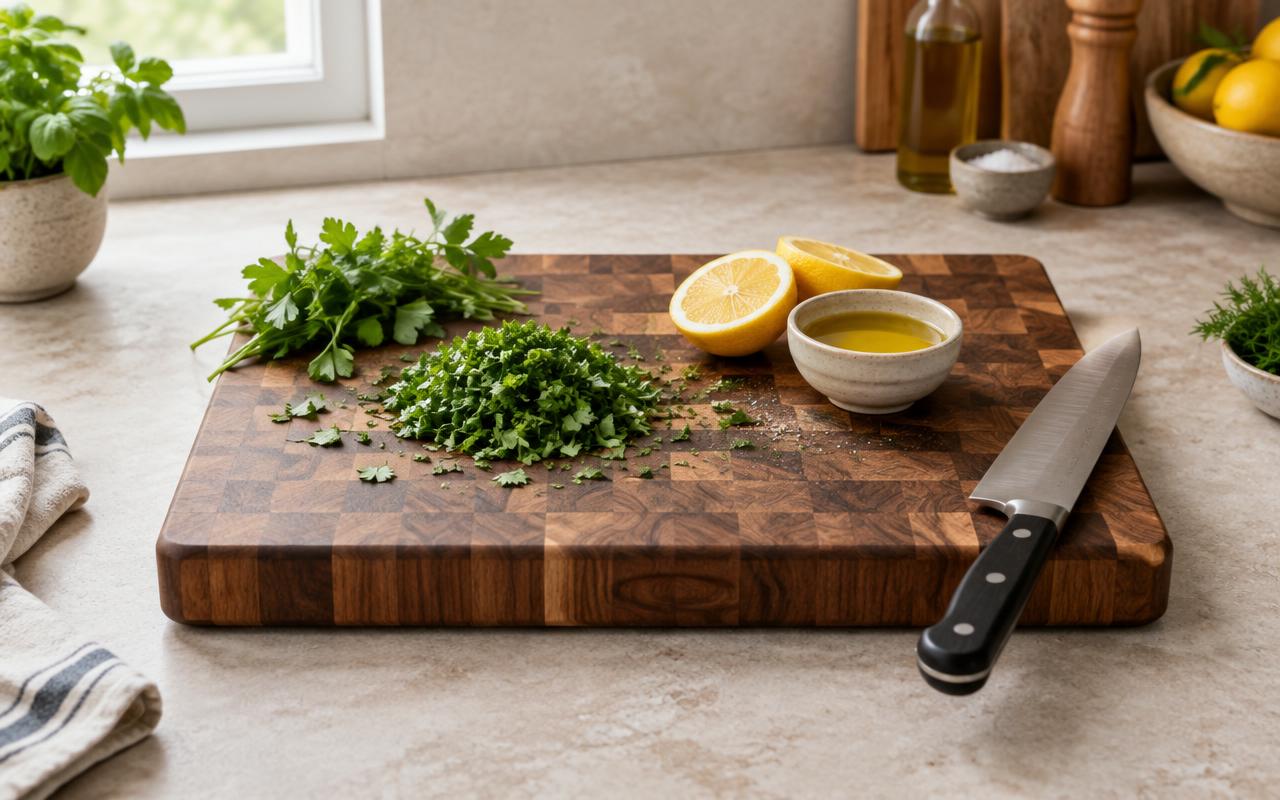
Most of us put up with the wrong board for years. It is too small, so food falls off the edge. It slides around the counter. Or it is glass or marble, which looks smart but dulls your knife in weeks.
The fix is simple. Buy one good wood board and one good knife, and look after them. They can last for decades. And unlike most kitchen tools, a handsome wood board is something you will want to leave out on display.
How to choose a cutting board
- Choose wood for everyday chopping. Wood is gentle on your knife and looks good on the counter. Many cooks also keep a plastic board just for raw meat, because it can go in the dishwasher.
- Know end grain from edge grain. End grain boards are made from short blocks with the wood fibers standing up, like the bristles of a brush. Your knife slips between the fibers, so it stays sharp for longer and marks hide better. Edge grain boards are made from long strips of wood. They are lighter, cheaper and very tough.
- Skip glass, marble and slate for cutting. They are too hard and will dull your knife fast. Keep them for serving.
- Go big. A board at least 16 inches long gives you room to chop without food falling off. A board that is too small is the most common mistake.
- Check that it stays put. Rubber feet, or a damp cloth underneath, stop the board from sliding.
- Want to carve meat? Look for a juice groove around the edge to catch the juices.
Group 1: The Cutting Board
The Splurge
Sonder Los Angeles Alfred End Grain Walnut Cutting Board
Sonder Los Angeles
$179
A thick end grain board in American black walnut, made by hand in small batches in the USA. One side has a juice groove that holds 3.5 oz. The other side has three built-in compartments to hold chopped food while you cook.
Details: 17" x 13" x 1.5" · American black walnut · End grain · Juice groove · Removable rubber feet · Made in the USA · 109 reviews, almost all five stars
Trade-off: It weighs 7.5 lb, so it is heavy to carry to the sink. Hand wash only, and oil it every 2 to 3 weeks.
View at Sonder Los AngelesThe Balanced Choice
Teakhaus Edge Grain Professional Cutting Board with Hand Grips
Crate & Barrel
$84.95
Teakhaus edge grain boards have long been the favorite wood board in America's Test Kitchen's tests. This one is made from FSC-certified teak, with a groove around the border to catch juices and crumbs, and grips cut into the sides.
Details: 16" x 12" · FSC-certified teak · Edge grain · Juice groove · Inset hand grips · Made in Vietnam · 23 reviews
Trade-off: Edge grain shows knife marks more than end grain. Hand wash only, and oil it now and then.
View at Crate & BarrelA great board deserves a sharp knife. A sharp knife is also safer than a dull one, because it cuts where you aim instead of slipping off the food.
You only need one good knife to start: an 8-inch chef's knife. It chops, slices, dices and minces almost everything.
Here is the main choice. German-style knives are heavier and tougher, so they can take a few knocks. Japanese-style knives are lighter, thinner and sharper, but their harder steel can chip if you cut through bones or frozen food. If you can, hold a knife before you buy it. A handle that feels good in your hand matters more than any feature.
Group 2: The Chef's Knife
The Splurge
Shun Classic 8" Chef's Knife
Shun
$189.95 (was $237)
The upgrade pick in America's Test Kitchen's chef's knife tests, praised for its very sharp blade. It is handcrafted in Seki City, Japan, with a hard VG-MAX steel core wrapped in rippled Damascus steel and a dark Pakkawood handle.
Details: 8" blade · VG-MAX steel core · Damascus cladding · Pakkawood handle · 6.7 oz · Made in Japan · Free lifetime sharpening · Limited lifetime warranty
Trade-off: Testers found the long, smooth handle hard to grip for smaller hands. Keep it away from bones and frozen food, which can chip the edge.
View at ShunThe Balanced Choice
Victorinox Fibrox Pro 8" Chef's Knife
Knife Merchant
$62
The winner in America's Test Kitchen's chef's knife tests. It is light, sharp and easy to sharpen, with a comfortable textured handle that does not slip.
Details: 8" blade · Stainless steel · Non-slip Fibrox handle · Made in Switzerland
Trade-off: The plain plastic handle is practical, not pretty. It looks like a restaurant knife, because it is one.
View at Knife MerchantPrices change often, so always check the shop before you buy. Amazon prices are shown on Amazon only.
How to make both last for years
- Never use the dishwasher. The heat and water can crack wood boards and dull knives.
- Wash and dry right away. Wash the board with warm, soapy water, dry it with a towel and stand it on its edge to dry fully. Wash and dry the knife straight after use.
- Oil the board when it looks pale or dry. Rub in a little food-safe mineral oil or board cream, leave it overnight and wipe off the extra.
- Hone the knife often. A few strokes on a honing steel every week or two keeps the edge straight.
- Sharpen once or twice a year. Use a sharpener, or take it to a professional.
- Store the knife safely. Use a knife block, a magnetic strip or a blade guard, never loose in a drawer.
Which one should you choose?
Choose the Splurge if you want an heirloom walnut board made in the USA and a Japanese knife that is as beautiful as it is sharp.
Choose the Balanced Choice if you want the tested favorites: a teak board for under $90 and a Swiss knife that won America's Test Kitchen's tests.
Choose the Save if you want a good board and a sharp knife for the least money.
You can also mix tiers. Splurge on the board, which you will see on your counter every day, and save on the knife.